
Whittier's Directory Shelf, 1903 to 1977
Whittier's historical directory record is not one continuous digital roll. The local shelf joins printed city directories, City Records volumes, telephone books, criss-cross titles, tax ledgers, Sanborn maps, newspapers, vital indexes, and yearbooks. The city directory run spans 1903 to 1977 but has gaps of one to three years. The 1903 volume is verified as R.L. Polk & Co.; later publishers are not all verified. Some items are in the History Room, some are digitized, and legacy collections require a library computer.
| Collection | Years | Where Held | Access |
|---|---|---|---|
| Whittier city directories | 1903-1977, 1-3 year gaps | History Room; 1903 and 1911 digitized | In-library; legacy view on library computers |
| City Records directory run | 1909-1977 | City Records Management | Consult local records staff |
| Whittier telephone directories, 57 volumes | 1904-1948 | Library digital and local originals | Library use; subscribers only |
| Haines Criss-Cross | 1972-present | History Room | Library use; name and address arrangements |
| Tax assessment ledgers | 1898-1956; index 1898-1919 | History Room, fragile materials | Staff-assisted research |
| Sanborn fire-insurance maps | 1888, 1891, 1894, 1900, 1907, 1912, 1925; updated to 1941 | Microfilm Reel 71 WH 912.794 SAN; museum originals | Library or museum research |
| Newspapers | 1888-present; digitized to February 1956 | Local newspaper collection | Digital archive or microfilm in the library |
| Vital Records Index | Vol. I 1888-1930; Vol. II 1931-1957 | Library use; WAGS abstracts | Index and notice trail, not a certificate |
Missing years do not automatically mark a move or a death. A publication gap, a changed address, a different postal exchange, or a name form can break a search. The Whittier library genealogy collection is the best first stop for shelf location and current access notes.
Whittier's City Directory Library Door
The Whittier Public Library History Room is on the Central Library mezzanine at 7344 Washington Avenue. The telephone is (562) 567-9900 and the research email is historyroom@whittierlibrary.org. Directories and books are requested at Information until one hour before closing. An identification item is left while using in-library materials. Confined items, yearbooks, and research help need an appointment.
The library's digital collections are migrating. The legacy system currently limits older collections to library computers, even when a catalog record or collection page can be found from home. The broader Los Angeles County Library catalog is another place to check for genealogy and local-history access. That is different from saying a volume is lost. Ask staff whether the desired scan is available in the building, whether the paper or microfilm copy is the working copy, and whether an appointment is needed. The historical publications collection is the useful route for telephone books and related local volumes.
Whittier Museum and Historical Society adds thousands of person, organization, home, business, church, and school files, more than 10,000 photographs, cemetery indexes, directories from 1903-1977, and combined address indexes. Research is listed Wednesday, Friday, and Saturday from 10 a.m. to 2 p.m.; call ahead.
The museum's historic resources collection provides a second place to ask about a directory clue, a house file, or an address index.
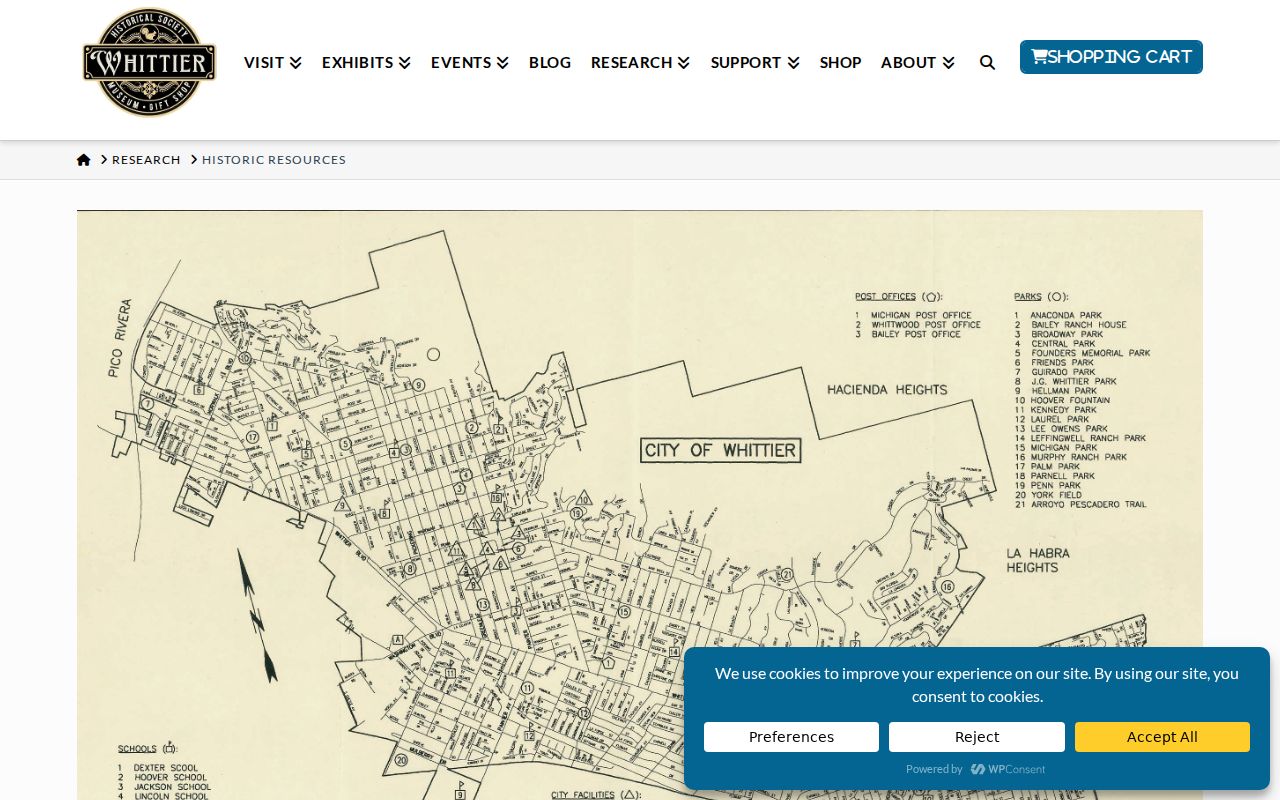
It can add a house file to a name and address.
How a Whittier Directory Entry Reads
A verified entry inventory is modest but useful. Library and museum descriptions support an occupant or full name, a spouse when printed, an occupation, and a residence address. Telephone and criss-cross volumes add a number when a person or business is a listed subscriber. Those fields should be treated as dated evidence, not as proof that a person owned a parcel or remained there all year.
| Occupant or full name | The person listed in the alphabetical section. |
|---|---|
| Spouse | A spouse name when the volume prints one. |
| Occupation | The occupation attached to that entry. |
| Residence address | The street address tied to the listed person. |
| Telephone | A number in telephone or criss-cross volumes when the person is a subscriber. |
A 1930 metadata example identifies “Kinnear Pictorial Service” at 220 S. Greenleaf, now the 7200 block. The old number needs a later address bridge.
- Reverse Street Guide
- The pink-paper address section used from 1920-1977 to turn an address into an occupant.
- Criss-cross directory
- A volume arranged by address as well as by name, including the Haines bridge after 1972.
- Subscriber
- A person or business listed in a telephone volume; a missing name may simply mean no listing.
- Tax-ledger index
- An index that points to taxable parcel owners and improvements, not a complete occupant list.
Note: Collection migration prevented inspection of a full 1903 or 1911 entry and its abbreviation key, so no unverified symbols are assigned.
Whittier Directory Years and the 1966 Address Reset
Address conversion is the hinge between older and newer city directory searches. Before 1966, Whittier used duplicate street numbers with directional clues, such as 102 N Greenleaf and 102 S Greenleaf. In 1966, the city changed all street numbers to the Los Angeles County system. Keep the old direction, abbreviated street name, and new number together rather than searching the modern number alone.
From 1920-1977, the pink Street Guide can turn an old address into an occupant. Read the whole street segment, not just one number. Nearby surnames and businesses help test whether the old-to-new conversion is right. A legal description, tract and lot, or later AIN is a stronger bridge than street text when a number changed.
| 1887 | Whittier founded as a Quaker colony. |
|---|---|
| 1898 | Incorporation; city minutes, ordinances, and resolutions begin. |
| 1903 | First city directory; R.L. Polk & Co. volume verified. |
| 1920-1921 | Reverse Street Guide appears for address-to-occupant work. |
| 1966 | Citywide conversion to the county street-number system. |
| 1977 | Final year in the identified city directory run. |
| 1972-present | Haines Criss-Cross provides a later address and name bridge. |
Whittier Telephone Directories Beyond City Lines
Fifty-seven Whittier telephone volumes run from 1904 through 1948. The Whittier Home Telephone and Telegraph Company volumes cover 1904-1935. Consolidated Telephone Company volumes for Whittier, La Habra, Rivera, and Pico cover 1939-1948. The geography reaches East, South, and North Whittier, Santa Fe Springs, Los Nietos, Potrero Heights, Rincon, Montebello, and Pico. In other words, the phone book's Whittier label can describe a wider postal and exchange area than incorporated city limits.
Only subscribers appear. A missing household could lack a telephone, use another subscriber's name, or sit outside the edition's exchange. A phone listing is a contact clue, not a full household count. Conventional phone books from 1968-2015 extend the shelf, while Haines supplies address and name arrangements from 1972 forward.
For a current address question, pair the historical volumes with the Whittier street directory and its modern record trail.
Haines in the Whittier Directory Trail
Haines Criss-Cross carries the directory trail from 1972 to the present. The 1972-1986 editions cover 35-37 East Suburban communities. Later editions cover 20-24 East San Gabriel Valley areas. The change in geographic scope is a key reading rule. A name absent from one edition may be outside that edition's coverage, not absent from the region.
Search Haines by address and then by name. Confirm the edition's community list before comparing years, and keep the volume beside the older directory or phone book that supplies the first clue.
Tax Ledgers Behind Whittier Directory Research
Tax assessment ledgers reach from 1898 to 1956, with indexes for 1898-1919. They can identify a parcel owner, improvements, cost, and other property before city directories become regular. The ledger is therefore valuable for an early owner or house history, but it is not a list of everyone living at an address. A directory occupant and a taxable owner can differ without either source being wrong.
Read the roles separately. A tax ledger points to a taxable owner and a directory points to a listed occupant. Treat a difference as a clue to test with deeds, census, or newspapers.
Sanborn sheets add the building layer. Whittier holdings include 1888, 1891, 1894, 1900, 1907, 1912, and 1925 sheets updated to 1941. Microfilm Reel 71, WH 912.794 SAN, is held for library research, and museum originals are another route. Sanborn maps show footprint, use, building material, and address continuity. They date the structure, not the household, so a map should support rather than replace a directory entry.
Newspapers and Vital Indexes for Whittier Directory Research
The newspaper shelf reaches farther than the digitized directory system. Digitized newspapers run from February 1888 through February 1956, while microfilm titles extend from 1888 to the present. The Daily News card catalog occupies about nine linear feet and indexes late-1970s through 2000s subjects and obituaries. An address, society notice, sale, death, or move can explain why a name appears in one directory and vanishes in the next.
The library's two Vital Records Index volumes contain more than 44,800 names: more than 11,000 in Volume I for 1888-1930 and 33,800 in Volume II for 1931-1957. Entries point to newspaper events involving adoption, birth, baptism, marriage, divorce, or death. The index is an abstract, not a certificate. Retrieve the cited notice, then use the proper county, state, court, or recorder custodian for authoritative proof.
Yearbooks add school context. Whittier High School runs from 1903-2015 and Whittier College from 1903-2012. Search a woman's birth, married, initial, and husband-style forms, including the library's Harriet Russell Strong examples: “Mrs. Charles Strong,” “Hattie Strong,” and “Harriet R. Strong.”
Tracing a Whittier Household Through Directories
A directory year is a dated observation, not a continuous claim of residence. Pair it with a census snapshot, a tax ledger, a newspaper notice, or a cemetery record. Federal census records from 1900-1950 are public under the 72-year rule, while the 1960 census release is set for 2032. The combination fills gaps without treating a missing listing as proof of a move.
The National Archives census research collection is the federal companion for checking a household against the local shelf.
Census snapshots can confirm household composition, while the city directory may supply an intervening address.
- Write down the known name, date range, old address, and every spelling or surname form.
- Convert a pre-1966 number and keep the old direction beside the modern number.
- Use the pink Street Guide for 1920-1977, reading the full street segment before opening the alphabetical entry.
- Record the printed name, spouse, occupation, address, and telephone when that field is present.
- Bridge 1972 forward with Haines by address and then by name, checking the edition's geographic scope.
- Pair each useful year with the nearest census and test a disappearance with newspapers, the vital index, probate, or cemetery records.
When a historical clue needs a modern court, voter, license, or business check, a focused Whittier resident lookup keeps the question on the right custodian.
Whittier Directory Names at Founders' Park
Founders' Memorial Park preserves a record trail that does not look like a directory. The city acquired the former Whittier, Mount Olive, and Broadway cemetery land in 1968, removed gravestones, and erected monuments naming 2,380 people. The burial list and map are available at City Hall by appointment. Rose Hills interment books add name, age, gender, death or burial date, cause, and doctor. Broadway's survey records 926 burials, 68 percent before 1910; Mount Olive's survey covers 365 burials from 1888-1957.
Whittier Area Genealogical Society, founded May 16, 1981, offers public meetings and free research help for deceased ancestors in greater Whittier. WAGS explicitly refuses living-person research and offline county-record retrieval. A request to research@wagswhittier.org should give the full name, target fact, place, period, and work already completed. That boundary makes the society a strong companion for family history, not a substitute for a current resident record.
Compare the date and source type, preserving original spelling, accents, hyphens, and both surname forms.