
Whittier Previous Residents by Era
One address in Whittier can carry several histories at once. The recorder holds the transfers. The History Room and the Museum hold evidence about occupants and houses. Census schedules add dated household snapshots. Maps, ledgers, permits, and newspapers fill the gaps between them. The table keeps those roles apart. A tax owner, a directory entry, and a past household never get mistaken for the same fact.
| Source | Years It Covers | Where Held | What It Shows |
|---|---|---|---|
| Recorder deed index | 1850/1851-present | RR/CC Norwalk | Grantor, grantee, recording data, legal description, title chain |
| Whittier city directories | 1903-1977, with gaps | History Room and Museum | Listed occupant, spouse, occupation, residence, reverse guide from 1920-21 |
| Haines criss-cross | 1972-present | History Room | Name, address, and telephone bridge by address and name |
| Tax assessment ledgers | 1898-1956; indexed 1898-1919 | History Room, staff-assisted | Parcel owner, improvements, cost, and other property |
| Federal census | 1900-1950 public | NARA and library databases | Household snapshot by enumeration district and address clues |
| Sanborn maps | 1888-1925; updated to 1941 | Library, Museum, Library of Congress | Footprint, use, materials, and lot or address continuity |
| Whittier permits | Paper scanning ongoing; no cutoff verified | City archive or focused request | Construction, remodel, applicant, contractor, and work dates |
| Newspapers and vital index | 1888-present; digitized through 1956 | Library local history | Moves, deaths, sales, obituaries, and indexed event notices |
Where you begin depends on the question. A current parcel points to the Assessor and the deed route. A 1930 household instead calls for the address conversion. The pink Street Guide, the alphabetic directory, and the census complete that route. A question about a structure points to Sanborn maps and ledgers. Deaths and moves surface elsewhere. A newspaper, vital index, cemetery file, or probate docket often catches a departure first. The official Los Angeles County real-estate records information describes the public scope of the county record set. It also explains the difference between a record copy and an online search.
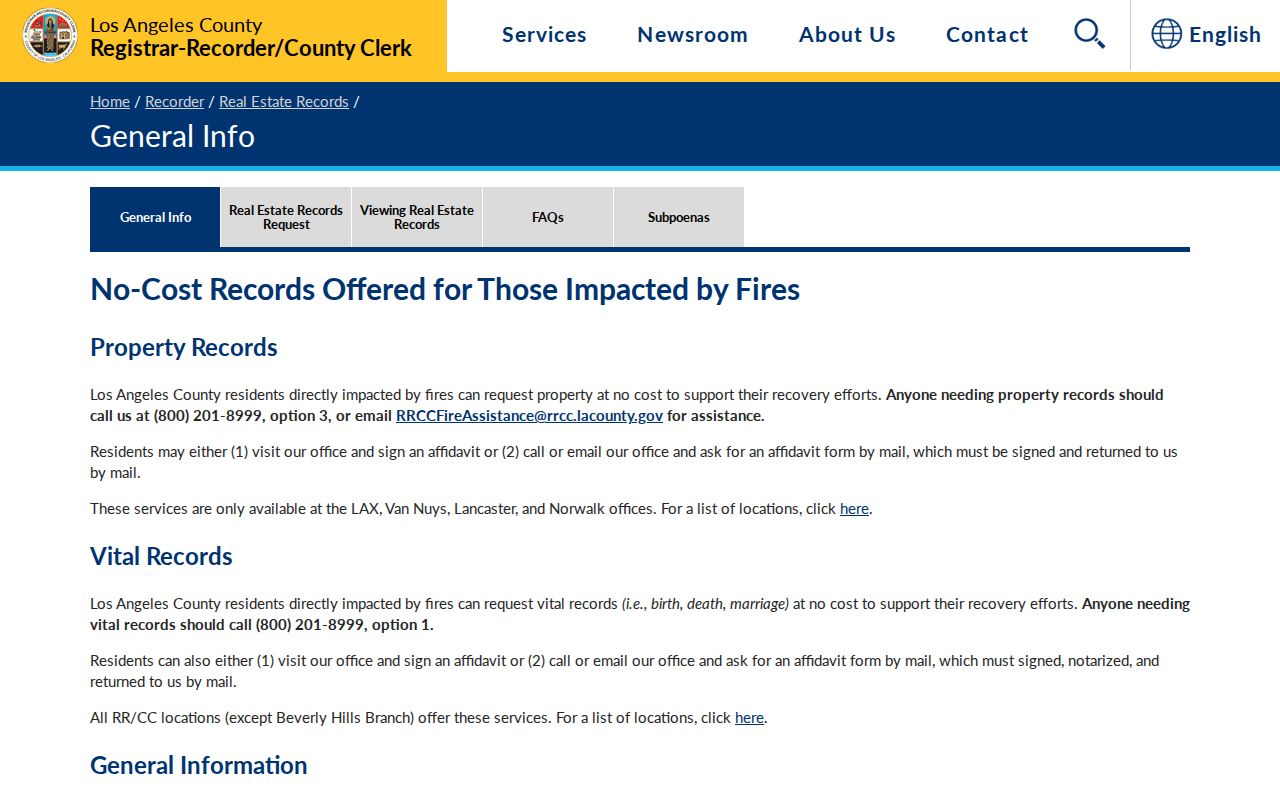
That county reference earns its place early in a past-resident search. It sets the public-record boundary before any name or address trail takes shape.
Whittier Previous Residents Start With AIN
Start with the Los Angeles County Assessor Portal. Search the situs address or the Assessor Identification Number. The result can reveal the formatted AIN, situs, parcel status, building and land facts, legal description, tract and lot clues, parcel-map links, and clues from reassessment-event documents. Owner names are another matter. The portal publishes no owner-name search for the general public online. Owner and mailing data require a visit to the Assessor East District counter or a Property Data Sales request.
The split matters. Situs is the parcel location. A mailing address is where tax notices go. When the two differ, the gap may hint at an absentee mailing arrangement, but it never proves who lives at the property. A permit applicant, contractor, trust, spouse, or business can appear in a record without being an occupant.
Before heading to Norwalk, write down the AIN, the legal description, tract and lot, the old and current street text, and any reassessable event document number. Those anchors keep a common name from becoming the first and only proof of residence.
Whittier Previous Residents and Norwalk Deeds
Los Angeles County deeds have been public since the mid-nineteenth century. Yet the county offers no public Internet index or image service. At Norwalk, the alphabetical grantor and grantee indexes are organized by person and recording year rather than street address. Records from 1851-1957 sit downstairs. Records from 1958 to the present sit upstairs. The county's general description says records date to 1850. So both date statements stand as useful access notes.
Norwalk is at 12400 Imperial Highway, Norwalk, CA 90650, open weekdays from 8 to 5. Appointments can be scheduled up to two weeks ahead. Staff will not run a telephone index search. Beverly Hills, LAX, and Van Nuys provide copies from 1982 forward. But the historical name-and-year trail belongs at Norwalk. The RR/CC viewing instructions show why. A Whittier address cannot go straight into a web form. Convert the address to an owner or seller name. Carry the recording year. Use the index room that holds that era.
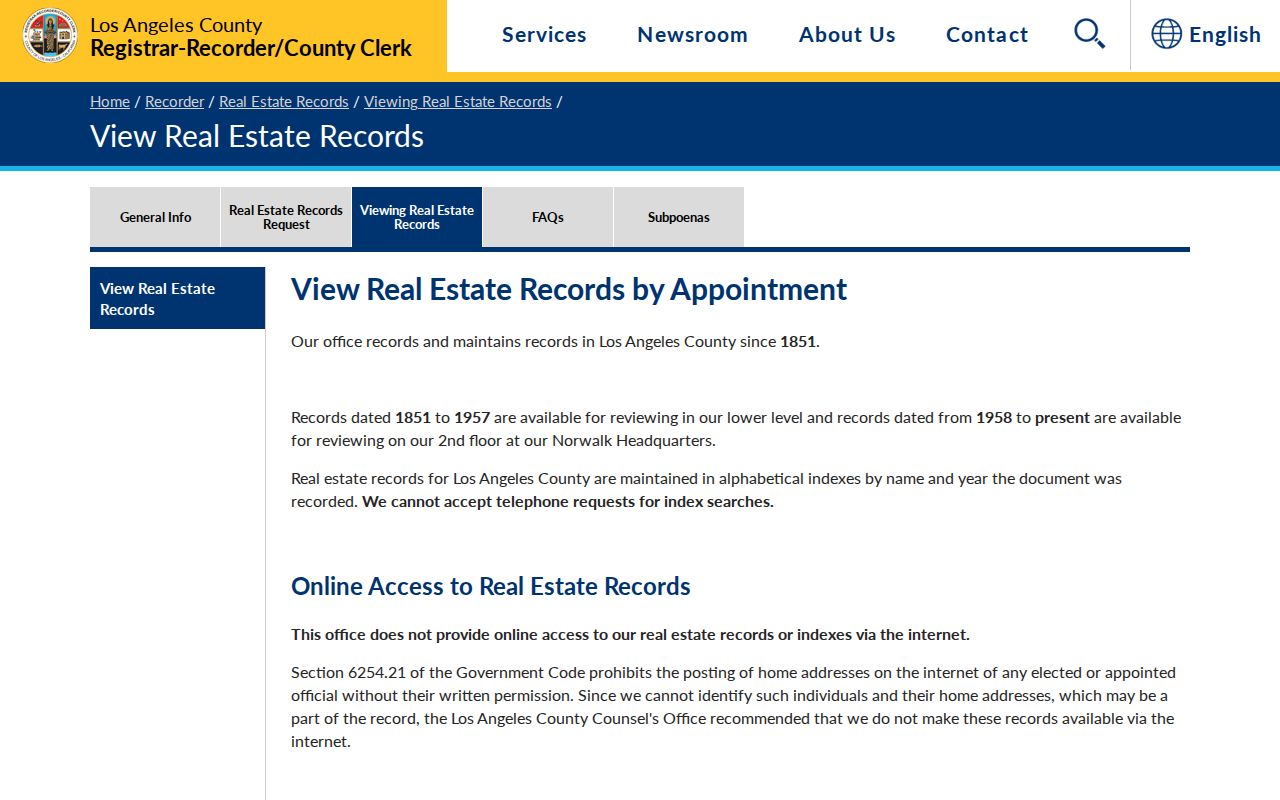
The Norwalk access view reinforces the central rule for previous residents. An AIN finds the land, but a person and a year open the recorded chain.
Trace Whittier Previous Residents by Deed
A deed chain is a sequence of recorded transfers. Tax-roll facts supply the clue, while the recorder index supplies the names, dates, document references, vesting, and legal descriptions. Search by role, not just spelling.
- Search the Whittier situs in the Assessor Portal and capture the AIN, tract and lot, legal description, building era, and event clue.
- Obtain the tax-roll owner or mailing clue from the Assessor East District or Property Data Sales. Mailing is not occupancy proof.
- At Norwalk, search the current owner as grantee near acquisition. Record the document number, date, vesting, parties, and legal description.
- Search each grantor as an earlier grantee, testing spouse, trust, business, initials, spelling variants, and nearby years.
- Repeat to the target era, using the AIN, tract, lot, parcel map, and legal description to stay on the same land.
- Grantor
- The person or entity transferring an interest in a recorded instrument.
- Grantee
- The person or entity receiving that interest. An earlier seller may appear as a prior grantee.
- Chain of title
- The linked transfers that show how title moved from one party to the next.
- Legal description
- The tract, lot, parcel, or other land description used when street text changes or repeats.
Note: A deed proves a recorded transfer and legal interest, but it does not by itself prove that a named party ever occupied the address.
Whittier Previous Residents and 1966 Addresses
Every Whittier street number changed in 1966 to the Los Angeles County numbering system. Before that conversion, a direction could separate duplicate numbers. A 1966 residents directory entry might list 102 N Greenleaf and 102 S Greenleaf. That distinction disappears the moment a modern search relies on the current number alone.
The library's Whittier Street Number Changes guide helps bridge the old and new systems. Keep the north or south direction attached to pre-1966 addresses. Search both abbreviated and spelled-out street forms. A city directory, newspaper notice, or deed can format the same street differently. A 1966 numbering mismatch often explains why a record seems to lose a house. The parcel never moved.
For continuity, the AIN, legal description, tract and lot, and parcel map all beat a postal or street label. The numbering change matters for another reason too: Whittier's 1961 annexation added more than 28,000 people. That widened the area where similar addresses and nearby names can be confused.
Whittier Past Households in Print
A deed proves who held title, but it rarely says who slept in the house. Whittier directories and census schedules do exactly that, fixing a person to an address at a stated time. The city directory run spans 1903 to 1977, broken by gaps of one to three years. From 1920-21 onward, the pink reverse Street Guide works backward from a street to an alphabetic entry listing name, spouse, occupation, and residence. Haines continues the address-to-name bridge from 1972 forward.
The Whittier Public Library History Room sits on the Central Library mezzanine at 7344 Washington Avenue, Whittier, CA 90602, reachable at (562) 567-9900 or historyroom@whittierlibrary.org. Ask for directory books at Information; they stay in the building. Appointments cover confined materials, yearbooks, and research help. For shelf detail, the Whittier city directory collection keeps every year tied to a single address.
- Write the modern address beside the pre-1966 number and direction.
- For 1920-1977, start with the reverse Street Guide and read the full street segment.
- Move to the alphabetic entry for occupant clues; from 1972 forward, check Haines by address and name.
- Pair the directory year with the closest public federal census year from 1900 through 1950.
- Test changes with newspapers, the Vital Records Index, obituaries, probate, cemetery indexes, and later directories.
Whittier Previous Residents and House Evidence
Sanborn maps show a structure, not every person who used it. Whittier's run covers 1888, 1891, 1894, 1900, 1907, 1912, and 1925, updated to 1941. The library holds microfilm Reel 71 WH 912.794 SAN. The Museum keeps originals, and the Library of Congress Sanborn collection offers a digitized route.
Tax ledgers from 1898-1956, indexed from 1898-1919, record parcel owners, improvements, and cost. They are staff-assisted history-room material. A ledger dates a building or improvement, not occupancy.
Whittier's Online Document Archive receives paper permits in sets, with no complete cutoff published. A released permit may show site address, applicant, contractor, parcel or project number, work, dates, and valuation. It may also show work, dates, and valuation. If a search returns nothing, send a focused address-and-era request to Building and Safety. You can also send it to the City Clerk.
The local house-history collection pairs well with tax ledgers and maps. It adds context about the building itself. Meanwhile, the deed and residents directory tracks keep the occupancy question anchored to dated evidence.
Close the Whittier Previous Residents Trail
Newspapers tie a past resident to real events. A move, a sale, or a death notice can surface. So can a society item, a business milestone, or an obituary. The local collection starts with titles from 1888. It runs digitized through February 1956. Microfilm fills current and earlier gaps. The Daily News card catalog indexes many subjects. It covers obituaries from the late 1970s through the 2000s. Search creatively: full names, initials, address variants, and the pre-1966 phone number.
The library's two Vital Records Index volumes hold more than 44,800 name entries. Volume I spans 1888-1930 with over 11,000 names; Volume II spans 1931-1957 with 33,800. The index points to notices, not certificates. For the authoritative record, go to RR/CC, CDPH, or the court.
The Los Angeles County Clerk keeps fictitious business names and marriage licenses. It also holds notary records, professional registrations, and domestic partnerships. These filings can confirm an association or event. But a filing address is not automatically a residence. Probate records add petitions, notices, relatives, and estate dates. The County Clerk services page is the source lead for those name-bearing county records.
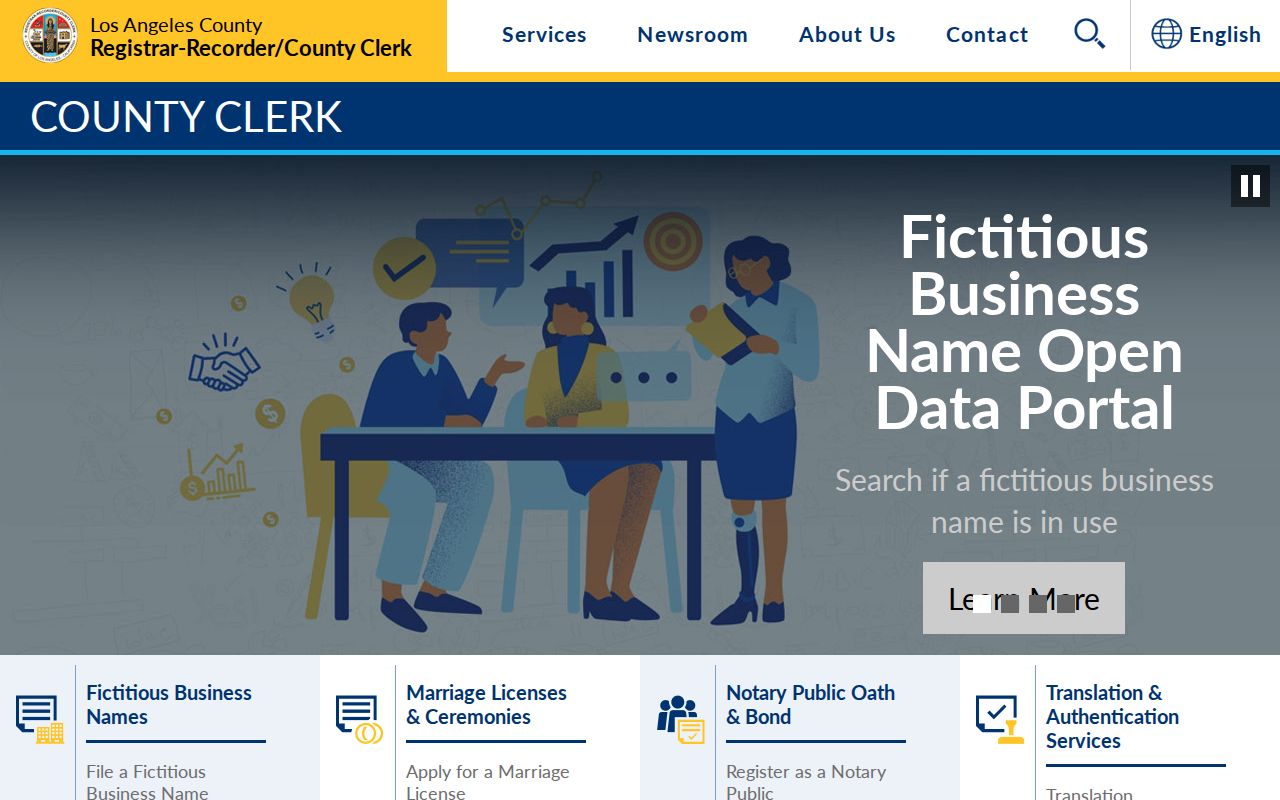
County Clerk material can close a family or business thread. Label it for what it proves, though, rather than treating it as a substitute for a deed or directory entry.
Whittier Previous Residents Copy Access
Once the exact document number is known, RR/CC opens several access channels. An online LexisNexis order is a paid copy request, not a public index. Mail requests go to Real Estate Records, PO Box 1130, Norwalk, CA 90651-1130, with title, parties, recording year or years, and payment enclosed. Fax requests use (562) 864-1250 and add delivery details, phone, and card information. A no-index search belongs at the Norwalk office.
Plain copies cost $5 for the first page plus $3 per additional page; certified copies run $6 plus $3 per additional page. Complete documents are required. In person, payment may be cash, check, money order, card, or digital wallet, with a $1.75 card service fee added. Online processing is stated at 20 working days. Check the RR/CC recording and copy-fee page before sending money, since fees and accepted methods can change.
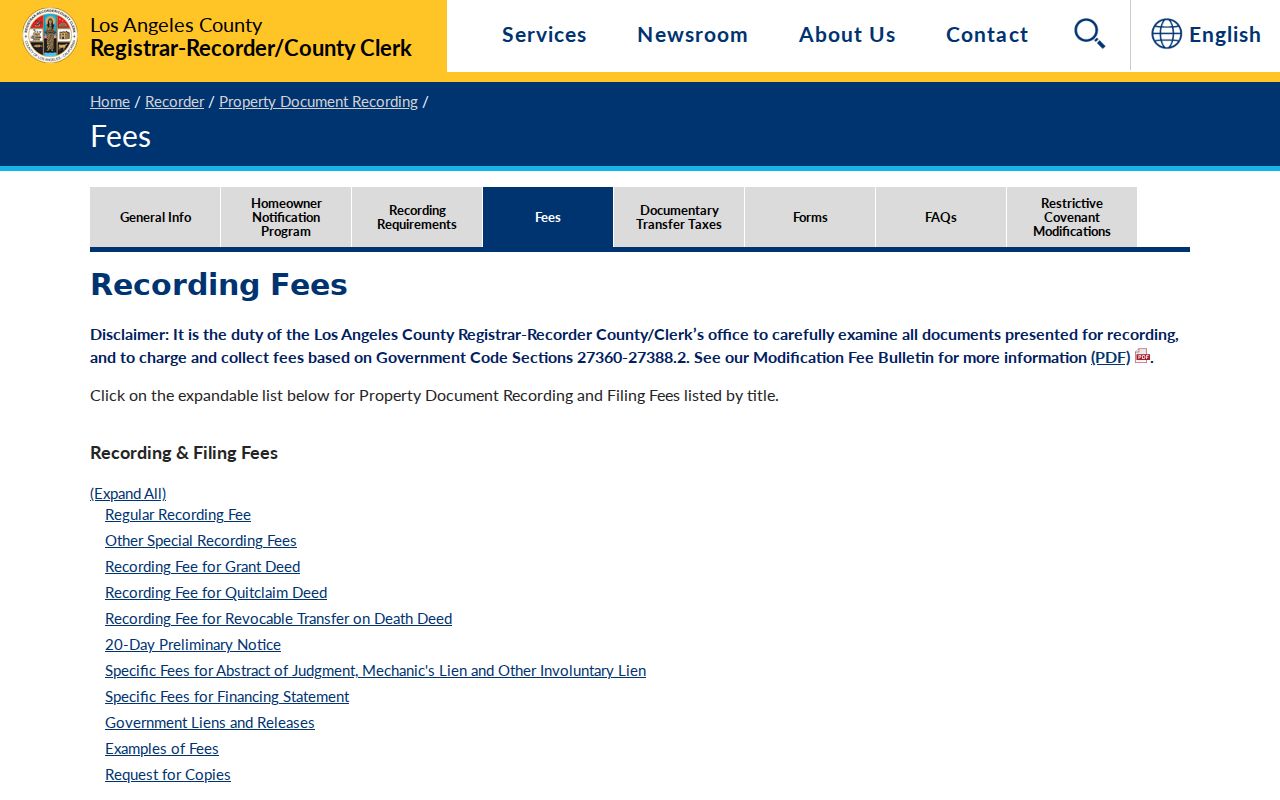
The fee reference belongs at the trail's end, once the document number and record type are settled. Knowing the copy price never turns an order into a deed search.
Lawful house history. Whittier previous residents research fits family history, estate work, property curiosity, and documented preservation. Do not use a past address trail to stalk, harass, intimidate, or track a living person. Confirm sensitive facts with the custodian and respect protected records.